We see it too often in Terrebonne: a geotechnical report uses generic cohesion values from a textbook instead of measured data from the actual site, leading to oversized footings or, worse, an underdesigned foundation. The silty-clay deposits along the Mille Îles River are layered, and their undrained shear strength can vary by 40 percent within a single meter of depth. When our team runs a triaxial test, we do it to replace assumptions with reality, giving the structural engineer the friction angle and cohesion intercept that reflect the exact material under the project. For sites where the stratigraphy is erratic, we often pair the triaxial with CPT testing to build a continuous strength profile before selecting the critical samples for the cell.
A triaxial test is not just a number for the report — it is the difference between a foundation that settles 12 millimeters and one that settles 45.
Methodology applied in Terrebonne
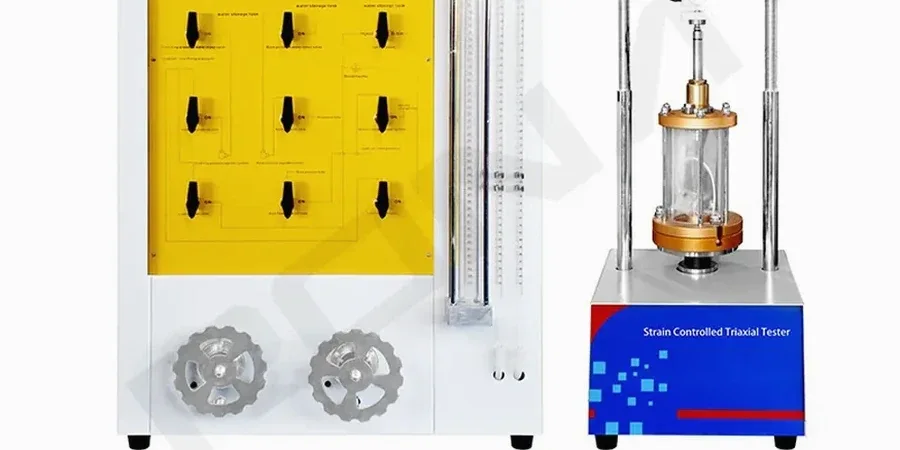
Local geotechnical conditions in Terrebonne
A practical observation from our geotechnical engineers in Terrebonne: many slope stability failures we review along the Mille Îles River banks trace back to triaxial test data that was collected at the wrong strain rate, overestimating the drained strength of the sensitive clay. The Leda clay, present in pockets across the region, loses more than half its undisturbed peak strength when remolded, and a standard triaxial test without careful sample preparation will miss this sensitivity entirely. If the lab report shows a cohesion value that looks too good to be true for a 12-meter-high cut, it probably is. We have seen cases where ignoring this led to a retaining wall leaning 8 degrees within the first spring thaw. For projects near the river, we recommend combining the triaxial with a slope stability analysis that uses the post-peak strength envelope, not just the peak, to design a safe setback or reinforcement scheme.
Our services
Our triaxial testing program in Terrebonne extends beyond the basic unconsolidated-undrained test. We tailor the consolidation and shear stages to the project's drainage conditions and construction timeline.
Consolidated Undrained Triaxial (CU)
With pore water pressure measurement to determine effective stress parameters c' and φ', essential for long-term stability analysis of cuts and embankments on Terrebonne's silty-clay formations.
Consolidated Drained Triaxial (CD)
For free-draining materials such as the sandy lenses found in the deltaic deposits near the Mille Îles River — the slow shear rate allows full pore pressure dissipation.
Unconsolidated Undrained Triaxial (UU)
A rapid test for saturated cohesive soils, giving the undrained shear strength Su for short-term bearing capacity checks under immediate loading conditions.
Multi-Stage Triaxial
When sample recovery is limited, we shear a single specimen at three confining pressures, producing a complete Mohr-Coulomb envelope from one core — practical for deep boreholes in glacial till.
Questions and answers
What type of triaxial test do I need for a foundation on Terrebonne's clay soils?
It depends on the loading timeline. For a shallow footing where the clay will not drain during construction, a UU triaxial test gives the undrained shear strength needed for short-term bearing capacity. If you are designing a permanent structure and need to account for long-term consolidation, a CU triaxial with pore pressure measurement provides the effective stress parameters c' and φ' that go into the drained analysis. Our team reviews the site stratigraphy and the structural loads before recommending the test type.
How much does a triaxial test cost in Terrebonne?
A standard triaxial test program in Terrebonne ranges from CA$2,670 to CA$4,120 depending on the number of specimens and the test configuration. A single UU triaxial on one specimen sits at the lower end, while a three-stage CU triaxial with pore pressure measurement on multiple samples approaches the upper end. We deliver a fixed-price quote after we know the borehole depth and the number of critical layers to test.
How do you ensure the sample is not disturbed before the triaxial test?
Sample disturbance is the biggest enemy of a reliable triaxial test. We use thin-walled Shelby tubes for cohesive soils and transport the cores in foam-lined boxes to our laboratory within 24 hours of extraction. Before mounting the specimen, we trim the ends carefully and measure the initial suction with a tensiometer. If the B-check during back pressure saturation does not reach at least 0.95, we reject the specimen and request a re-sample from the field crew — better to delay a report than to deliver wrong strength parameters.
Can you run a triaxial test on granular soils from the Lachenaie area?
Yes, but it requires a different approach. The sandy and gravelly lenses in Lachenaie's glacial deposits do not hold a cylindrical shape without confinement. We prepare remolded specimens at the field density using a split mold and run a drained triaxial test at a slow shear rate to allow pore pressure dissipation. The result is a friction angle that reflects the actual relative density of the material, which is critical for bearing capacity calculations on granular footings.
What is the difference between a triaxial test and a direct shear test for my project?
A triaxial test gives you control over the drainage conditions and allows measurement of pore water pressure during shear — something a direct shear box cannot do. For the sensitive clays in Terrebonne, knowing the effective stress path matters because the pore pressure at failure can reduce the available shear strength significantly. The triaxial cell also applies a more realistic stress state to the sample compared to the fixed shear plane of a direct shear box. We use the triaxial when the project involves deep excavations, slopes, or structures sensitive to settlement.