Terrebonne sits at an elevation of roughly 20 meters above the St. Lawrence Lowlands, where the surficial geology shifts abruptly from compact glacial till to pockets of soft Champlain Sea clay. This transition zone, combined with a population that surpassed 120,000 in recent years, means every new foundation or municipal project in the Mille-Îles corridor demands subsurface data that captures these contrasts. The Standard Penetration Test (SPT) remains the most direct method to sample and measure resistance through these layers, generating N-values that feed directly into bearing capacity calculations under the National Building Code of Canada. When a drill rig advances through sand lenses near the river or encounters sensitive clay at depth, the blow-count record becomes the primary language between the geotechnical engineer and the structural designer, and in Terrebonne that conversation happens early in almost every project because the soil profile rarely matches the surface appearance.
A single SPT boring in Terrebonne can move through three distinct depositional environments in under 15 meters, and the N-value shift at each contact tells the real story.
Methodology applied in Terrebonne
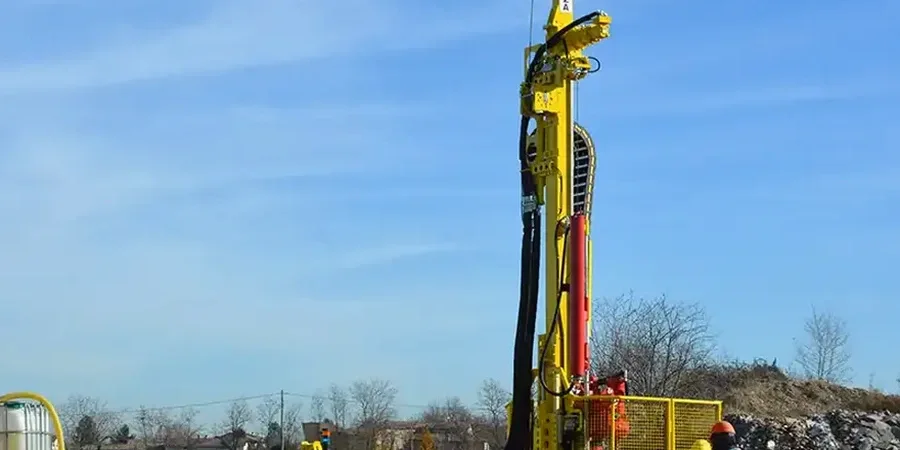
Local geotechnical conditions in Terrebonne
Champlain Sea clay dominates the low-lying sectors of Terrebonne, and its sensitivity to disturbance means an SPT blow count alone can underestimate the true in-situ behavior if the clay structure collapses during sampling. In the eastern parts of the city, where the till is thinner and the bedrock surface irregular, refusal can occur at unpredictable depths, forcing contractors to rethink foundation types mid-project. The most costly surprises we have seen come from buried organic layers in former marsh zones near the river, where N-values drop to single digits and consolidation settlement becomes the controlling design parameter. A geotechnical investigation that skips the SPT in these areas leaves the structural engineer without the stratigraphic detail needed to size footings correctly under NBCC Part 4, and the remediation cost after construction multiplies quickly.
Our services
The SPT program in Terrebonne generates a continuous log of penetration resistance and disturbed samples, but the value of that data multiplies when it feeds directly into the design parameters and complementary site investigations that follow.
SPT Borehole Logging and N-value Correction
Each SPT boring in Terrebonne is logged by a field engineer who records blow counts, sample recovery, and water observations in real time. Back in the office, raw N-values are corrected for overburden pressure, hammer energy, and rod length to produce N60 values that the structural engineer can use directly in bearing capacity equations and settlement estimates under NBCC 2020.
Liquefaction Screening for Terrebonne Sites
For any project east of Autoroute 25 where sand deposits are mapped within the upper 20 meters, we run a liquefaction triggering analysis using the corrected SPT blow counts, the fines content from lab tests, and the NBCC spectral acceleration at the site. The output is a factor of safety profile that tells the design team whether ground improvement or deep foundations are required before construction starts.
Questions and answers
What does an SPT test in Terrebonne typically cost for a standard residential lot?
For a single-family home lot in Terrebonne, an SPT investigation with one borehole to 10 or 12 meters depth, including the drill rig mobilization, field logging, and a summary report with corrected N-values, runs between CA$760 and CA$1,080. The final figure depends on access conditions, the number of boreholes required by the municipal permit, and whether the clay depth demands a deeper termination criterion.
How many SPT boreholes does the Terrebonne building department usually require?
The city follows the NBCC guidelines, which for a typical Part 9 residential building call for a minimum of one borehole per building footprint, with additional boreholes if the footprint exceeds 200 square meters or if the soil conditions vary noticeably across the site. For larger commercial projects in the Terrebonne industrial park, the geotechnical engineer of record often specifies three or more to capture the lateral variability of the Champlain clay and underlying till.
Can the SPT tell me if my Terrebonne property has liquefaction risk?
Yes, the SPT is the most common field test used to screen for liquefaction potential. The corrected N-values from the test, combined with the grain-size distribution of the samples and the seismic hazard data from the NBCC for Terrebonne, feed into the Seed-Idriss simplified procedure. If the factor of safety drops below 1.0 for any layer, the report will flag it and recommend either ground densification or a deep foundation solution that bypasses the liquefiable zone. More info.