A common mistake in Terrebonne is assuming the deep, grey clays on a lot are uniform just because the surface is flat. A few standard boreholes might miss a thin, loose silt lens at 11 meters that completely changes the seismic site class. We see this often in projects near the Mille Îles River, where alluvial deposits hide complex stratigraphy. The cone penetration test (CPT) eliminates that guesswork by providing a continuous, high-resolution log of tip resistance and sleeve friction. Since 2021, the updated NBCC seismic provisions for the St. Lawrence Lowlands have made accurate shear wave velocity profiles essential. Our team brings a calibrated electric cone rig to Terrebonne sites, logging data every 2 centimeters. The result is a detailed picture of the stratigraphy without the disturbance of traditional drilling.
Continuous CPT profiling in Terrebonne's Champlain Sea clays reveals thin silt seams that standard split-spoon sampling misses, directly impacting the seismic site classification under NBCC.
Methodology applied in Terrebonne
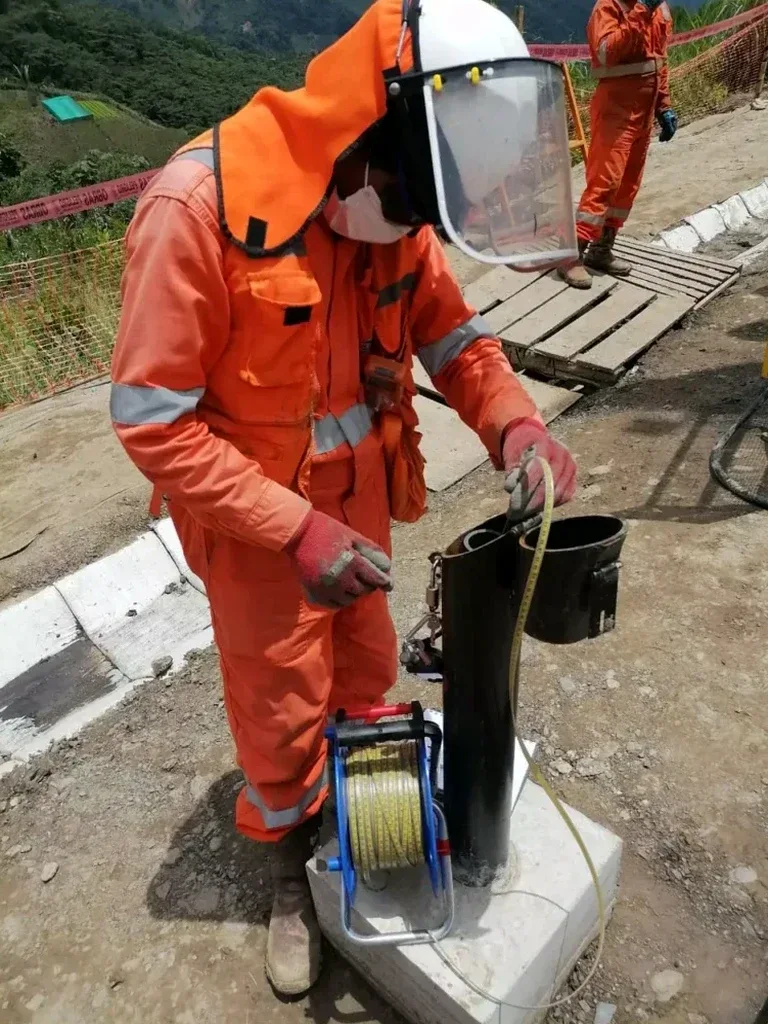
Local geotechnical conditions in Terrebonne
The weather contrast in the Lower Laurentians creates a specific risk for soil investigation: a dry summer can mask the true sensitivity of the marine clays. Terrebonne rests on deposits of the ancient Champlain Sea, and these silty clays can lose up to 80% of their strength when remolded. A CPT profile taken during a drought might show high tip resistance, but a subsequent wet season can trigger a sudden loss of bearing capacity if the data is misinterpreted. We cross-reference the pore pressure dissipation tests with the corrected cone resistance to flag these sensitive clays before the excavation phase. Ignoring this step risks a costly slope failure in a deep excavation or a differential settlement problem in a slab-on-grade.
Our services
Our CPT works in Terrebonne cover the full range of subsurface investigation needs, from preliminary site screening to detailed parameter derivation for numerical modeling. We deploy a truck-mounted system capable of accessing most urban and light industrial sites without the need for extensive ground preparation.
Standard CPTu Profiling
We push an electric piezocone with pore pressure transducer to depths of up to 30 meters, delivering a continuous log of qc, fs, and u2. The data is processed to estimate undrained shear strength, overconsolidation ratio, and equivalent SPT N60 values for direct input into geotechnical reports.
Seismic CPT for Site Class
We integrate a downhole geophone array into the cone string to measure shear wave velocity (Vs) every 1 meter. This provides the direct measurement needed for NBCC 2020 Site Class determination, eliminating reliance on empirical correlations and often yielding a more favorable — and accurate — classification.
Questions and answers
What is the typical cost of a CPT test in Terrebonne?
For a standard CPTu sounding in the Terrebonne area, the cost typically ranges from CA$250 to CA$360 per sounding, depending on the total depth required and the number of dissipation tests. A full day of investigation with mobilization and a seismic module will be quoted based on the specific project scope.
Can a CPT rig access a residential backyard in Terrebonne?
Our truck-mounted CPT system requires about 2.4 meters of width clearance and a stable access path. For backyards with limited access, we can use track-mounted portable units, though the maximum thrust is lower. We always conduct a pre-visit site check in neighborhoods like Lachenaie or La Plaine to confirm accessibility.
How does CPT help with the seismic design of a foundation?
The CPT provides a direct measurement of sleeve friction and tip resistance, which correlates strongly to the small-strain shear modulus. When we include a seismic cone module, we measure shear wave velocity (Vs) directly. This allows us to calculate the average Vs for the top 30 meters (Vs30) and assign the correct Site Class per NBCC 2020, which directly influences the seismic design forces on the structure.
What is the difference between a CPT and a standard borehole?
A standard borehole with split-spoon sampling recovers disturbed samples at intervals (usually every 1.5 meters) and provides an N-value. A CPT pushes a calibrated cone continuously and records data every 2 centimeters, offering a near-continuous profile of soil behavior without sample disturbance. It is faster and cleaner, though it does not retrieve a physical sample for visual classification. More info.