Terrebonne’s expansion from a quiet seigneurial mill town to a booming north-shore suburb didn’t happen on ideal ground. Much of the development pushed onto the post-Champlain Sea deposits, and that means we deal with thick sequences of sensitive silty clay across most of the municipality. We see it on Île-des-Moulins redevelopments and in the new residential phases near Lachenaie. When the natural soil can’t handle isolated footings, the answer is usually a raft or mat foundation. Our office has designed dozens of them for this specific geology, where a stiffened slab becomes the only sensible way to bridge soft spots and control differential settlement. A well-executed CPT test gives us the continuous stratigraphy we need, and we often pair it with a triaxial test to lock down the undrained shear strength before finalizing the raft geometry.
On Terrebonne’s sensitive clays, a mat foundation isn’t just a thicker slab; it’s a bridge that stops differential movement before it starts.
Methodology applied in Terrebonne
Live process video
Local geotechnical conditions in Terrebonne
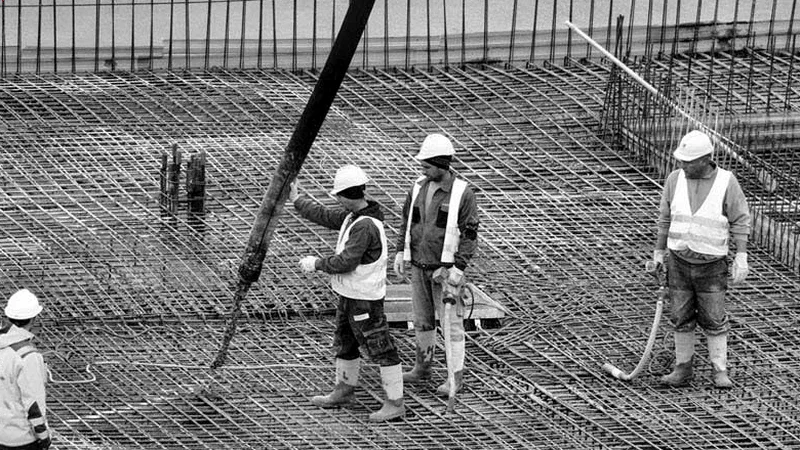
The most common mistake we correct is a contractor pouring a uniform-thickness mat without stiffening ribs, assuming the clay is homogeneous. It is not. The organic silt pockets scattered through Terrebonne’s glacial-lacustrine plain create abrupt stiffness contrasts. Skip the ribs, and you will see angular distortion cracks in the partition walls within two freeze-thaw cycles. Another frequent headache is excavating to grade and leaving the cut open over a rainy weekend. The Champlain clay surface turns to slurry, and the bearing capacity drops by half. We require a protection plan in the specs. When the soil investigation only includes boreholes at the corners, the central settlement gets missed entirely. A dense CPT grid catches those soft lenses early and keeps the mat design honest.
Our services
The scope of a mat foundation package changes with the building footprint and the bedrock depth, but these two phases always anchor the work.
Full Raft Geometry and Reinforcement Design
We model the soil-structure interaction using modulus of subgrade reaction values derived from field tests, not textbook guesses. The output is a complete set of stamped drawings covering slab thickness, rib layout, and rebar schedules per CSA A23.3.
Settlement Monitoring and Pre-Construction Verification
For larger commercial mats in Terrebonne, we install settlement plates and piezometers before the pour. This confirms the consolidation assumptions and gives the structural engineer a real-time look at how the Champlain clay is responding.
Questions and answers
What’s the cost range for a raft foundation design package in Terrebonne?
For a typical single-family or light commercial mat foundation in the north shore region, the engineering design, site investigation, and stamped drawings usually fall between CA$1,480 and CA$6,410. The spread depends on the number of CPT soundings, the complexity of the rib layout, and whether we need to run a full seismic site response analysis per NBCC 2020.
Why choose a mat foundation over strip footings in this area?
Strip footings work when the bearing stratum is competent and uniform. In Terrebonne, the Champlain Sea clay is often neither. A mat spreads the structural load over the entire footprint, smoothing out the soft spots and reducing the risk of differential settlement that would crack the superstructure.
How deep do you typically need to place a mat foundation here?
Depth is driven by frost protection and the removal of desiccated crust. In Terrebonne, the frost penetration depth is 1.8 m per NBCC, so the bottom of the mat must be at or below that elevation unless insulated. We often excavate through the weathered upper clay to reach the intact, grey material below.
Can you design a raft for a building with a basement on high groundwater?
Yes, and it is a common scenario near the Mille Îles River. We design the mat as a buoyancy raft, checking flotation with a factor of safety of 1.2 under the design groundwater level. A drainage blanket and perimeter drain are integrated into the section to relieve hydrostatic pressure during construction.
What site investigation do you need before starting the mat design?
We need a minimum of three CPT soundings with pore pressure measurement for a residential footprint, plus one sampled borehole with Shelby tubes for lab testing. The test pits are useful for assessing the fill thickness, but the CPT gives us the continuous undrained shear strength profile we can’t get any other way in this clay.