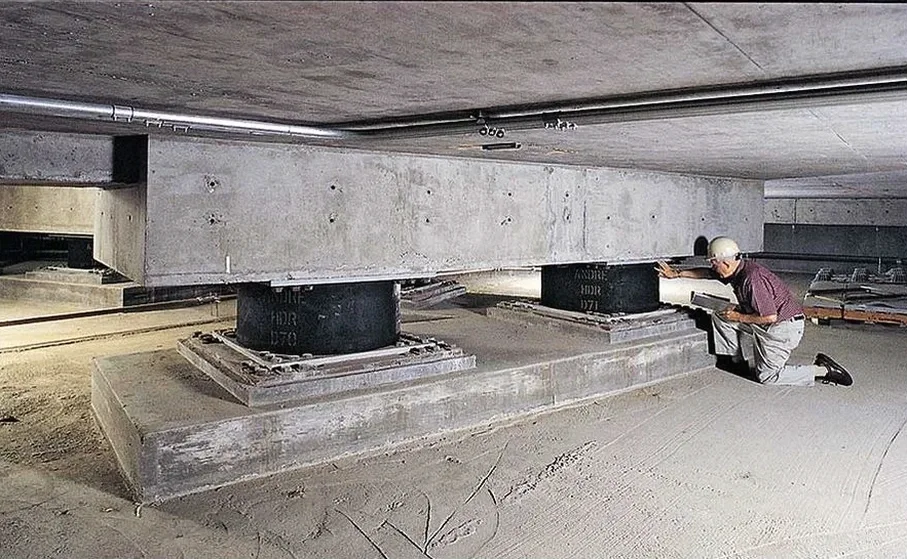
In Terrebonne, a lot of what we see on the geotechnical side comes down to the marine clay that blankets much of the lower Laurentides. When a structural engineer starts looking at seismic isolation for a new building near the Mille-Îles River, the first thing we ask is how the clay will behave under long-period motion. Base isolation design lives and dies by the accuracy of the soil profile you feed into it. Get the shear wave velocity wrong in those upper 30 meters and the isolator period could end up sitting right on top of a site resonance peak. Our lab on the North Shore supports these projects with site-specific data: downhole Vs profiles, consolidation parameters from undisturbed Shelby tube samples, and index testing that ties back to the actual stratigraphy we log on site. For projects where the clay is thin and rock is shallow, we often combine the investigation with seismic refraction to map the bedrock surface precisely before anyone models the isolation layer.
In Terrebonne's Champlain Sea clay, the site period often hovers between 0.8 and 1.2 seconds—getting that number right is what prevents the isolator from amplifying motion instead of reducing it.
Methodology applied in Terrebonne
Local geotechnical conditions in Terrebonne
The Champlain Sea clay that underlies much of Terrebonne has a sensitivity that can surprise engineers unfamiliar with the region. When you excavate for the isolation pit or the foundation mat, the unloading can trigger a loss of strength in a material that looked perfectly competent in the Shelby tube. Sensitivity values above 15 are common, and we have measured values over 40 in some pockets east of Highway 25. That means a slope failure during excavation is a real operational risk, not just a textbook scenario. Add the seismic demand—Terrebonne sits in a moderate hazard zone under NBCC 2020, with a 2% in 50-year spectral acceleration that demands careful attention to site amplification—and you start to see why the isolator design cannot rely on generic soil profiles. The combination of soft clay and a shallow water table also means that any drainage failure around the isolation interface can alter the dynamic properties over time, something we flag early in the geotechnical report so the civil team can design the perimeter drainage accordingly.
Our services
For a base isolation project in Terrebonne, the investigation has to go deeper than a standard bearing capacity check. These are the two service packages we prepare most often:
Site-specific seismic site response analysis
We build a one-dimensional wave propagation model using Vs profiles from downhole or surface wave methods, calibrated with lab-derived modulus reduction and damping curves. The output is a design spectrum at the isolation interface that reflects actual site amplification rather than the default NBCC factors.
Cyclic laboratory testing program for isolator design
A suite of resonant column, bender element, and cyclic triaxial tests on undisturbed samples from the bearing stratum. We report G/Gmax degradation curves and damping ratio versus shear strain, formatted for direct input into structural analysis software like ETABS or SAP2000.
Questions and answers
What soil information does a structural engineer need for base isolation design in Terrebonne?
They need a site-specific shear wave velocity profile down to at least 30 meters, modulus reduction and damping curves for the soils that will support the isolation interface, and a clear description of the stratigraphy including bedrock depth and any soft clay layers. The spectrally matched ground motions they use in time-history analysis depend entirely on these inputs.
How deep do you typically drill for a seismic isolation investigation?
In Terrebonne we typically go to refusal on the bedrock, which can range from 5 meters near the riverbank to over 30 meters in the deeper clay basins. At least one borehole is cored 3 to 5 meters into competent rock to confirm it is not a boulder. The depth requirement is driven by the need to calculate Vs30 and to identify any impedance contrasts that could affect wave propagation.
What is the typical cost range for a geotechnical investigation supporting base isolation design?
For a full program including drilling, undisturbed sampling, Vs profiling, and a cyclic laboratory testing suite, projects in the Terrebonne area generally fall in the range of CA$6,500 to CA$10,500. The final cost depends on the number of boreholes, the depth to bedrock, and the specific lab tests required by the structural engineer.
How does the local Champlain Sea clay affect the isolation system design?
The high sensitivity and low shear strength of the clay mean that excavation support and dewatering are critical, and the clay's stiffness degradation under cyclic loading can amplify long-period motion if the site period is not accurately measured. We address this by testing the clay's dynamic properties at strain levels that match the design earthquake, ensuring the isolator period is tuned to avoid resonance with the site.