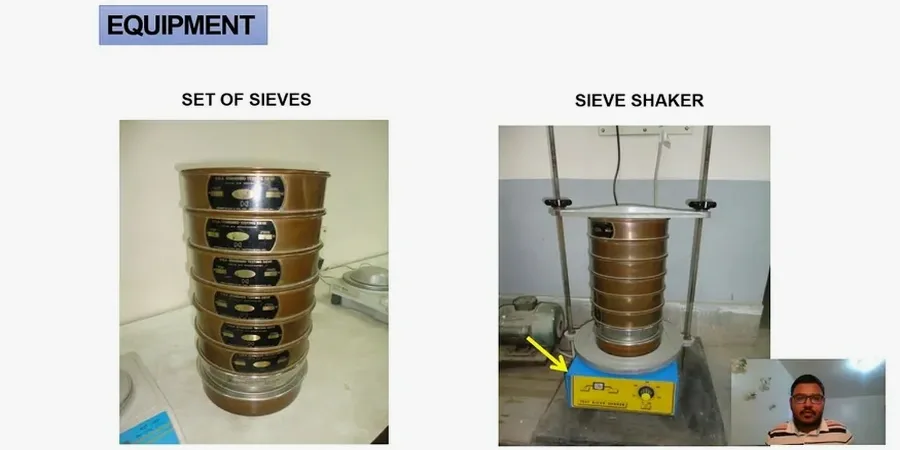
The north shore of the Mille Îles River hides a complex soil history. Terrebonne sits atop Champlain Sea clays and deltaic sands deposited roughly 10,000 years ago when the post-glacial sea inundated the lowlands. This means any excavation here can transition from dense till to sensitive silty clay within a couple of meters. Our grain size analysis combines mechanical sieving for the coarse fraction with a hydrometer test for fines, producing a full curve from 75 mm down to 0.001 mm. Without that hydrometer tail on the distribution, you are guessing about drainage, frost susceptibility, and liquefaction potential. The ASTM D422 / D6913 framework guides our procedure, but local track record tells us the real challenge is sample preparation when those varved clays from the Lachenaie sector arrive at the lab still holding their seasonal water content.
A missing hydrometer analysis on Terrebonne clay can misclassify your seismic site class by a full letter, with six-figure structural consequences.
Methodology applied in Terrebonne
Local geotechnical conditions in Terrebonne
One thing we see repeatedly in Terrebonne is contractors submitting a sieve-only report for a silty sand and assuming drainage will work. Then the spring thaw hits, the fines percentage—which nobody quantified—turns out to be 22%, and the backfill behind the foundation wall freezes and heaves. A full grain size analysis with hydrometer would have flagged that material as frost-susceptible under the CSA A23.3 criteria. Another common headache: using a bulk sample from a test pit without removing the cobbles first, which skews the entire coarse fraction and gives a false D60. We quarter and split every sample in the lab according to ASTM C702, because the numbers you plug into your seepage model or filter design are only as good as the subsample that actually went through the sieves. In the Île-des-Moulins area, where historical fill overlies natural alluvium, we often run two separate analyses on the same borehole—one on the fill, one on the native soil—to avoid contaminating the natural gradation curve with brick fragments and ash.
Our services
Our laboratory in the Lanaudière region processes grain size analyses for geotechnical consultants, municipal infrastructure departments, and environmental firms. We handle the full workflow from sample reception to signed report, with ISO 17025 accredited procedures ensuring traceability across every sieve and hydrometer reading.
Full Particle Size Distribution (Sieve + Hydrometer)
Combined mechanical sieve analysis and sedimentation hydrometer test producing a complete gradation curve from gravel to clay fraction. Includes calculation of uniformity coefficient, coefficient of curvature, and USCS classification per ASTM D2487. Typical turnaround is five working days, with rush analysis available for active construction sites where excavation has exposed unexpected fine-grained layers.
Wash Sieve and Fines Content Verification
Targeted wash analysis (ASTM C117) on granular materials to quantify the percent passing the 75 µm sieve. Often requested for filter aggregate compliance, concrete sand specification checks, and frost-susceptibility screening of backfill materials before placement in Terrebonne's frost-active zone, which extends to approximately 1.4 meters depth.
Questions and answers
Why do I need the hydrometer analysis if my soil looks sandy?
Visual classification is deceptive in the Champlain Sea deposits around Terrebonne. A sand that appears clean in the field can carry 12 to 18 percent silt and clay, which completely changes its drainage behavior and frost susceptibility. The hydrometer quantifies that fine tail, giving you the actual silt and clay fractions needed for USCS classification and seismic site response modeling under NBCC 2020.
What is the typical cost for a combined sieve and hydrometer test?
For a standard composite sample processed through full sieve stack plus hydrometer, you can expect a range between CA$140 and CA$230 per specimen, depending on whether you need a single-point hydrometer or a multi-point curve with several readings over 24 hours. Samples with high organic content or requiring special dispersion pre-treatment fall at the upper end.
How does grain size analysis help with seismic site classification?
The NBCC 2020 allows site class determination using undrained shear strength or SPT N-values in fine-grained soils, but when you are dealing with interbedded sands and silts, the grain size distribution provides the supporting evidence to confirm whether a layer is cohesive or granular. A high clay fraction from the hydrometer pushes the classification toward Site Class E in deep deposits, directly affecting the design spectral acceleration your structural engineer must use.
Can you test samples with gravel and cobbles?
Yes. We follow ASTM D6913 for coarse fractions, including particles up to 75 mm. For material with significant cobble content, we run a parallel cobble-weighting procedure so the final gradation curve correctly represents the in-situ material, rather than discarding the oversize fraction and skewing the D60 upward.
What sample mass do you need for a complete analysis?
It depends on the maximum particle size. For soils with Dmax under 4.75 mm, 500 grams usually suffices. If the material contains gravel up to 19 mm, we need at least 2 kilograms. Our lab provides sampling guidance specific to Terrebonne's typical alluvial deposits, and we can supply sample bags and labels for your drill crew before they mobilize. More info.