Terrebonne’s growth along the Rivière des Mille Îles has transformed former agricultural lowlands into dense residential and commercial zones. The silty sands and soft clays typical of the Lanaudière region demand rigorous compaction control—without it, differential settlement appears within the first two freeze-thaw cycles. The sand cone field density test remains the reference method here because it delivers a direct, physical measurement of in-place density, unaffected by the magnetic interference that disturbs nuclear gauges near buried utilities. When backfill goes in behind a new foundation wall in Lachenaie or a service trench is cut through La Plaine, the NBCC requires proof that the specified percentage of Standard Proctor maximum density has been achieved. That proof comes from a technician weighing sand, excavating a clean hole, and calculating the wet and dry density on site. For deeper verification of native soil bearing capacity before compaction begins, our team often pairs this test with standard penetration testing to confirm stratigraphy below the compacted lift.
A sand cone test result above 95% of Standard Proctor is the single most defensible number on a compaction sign-off sheet in Terrebonne.
Methodology applied in Terrebonne
Key field density characteristics for Terrebonne projects include:
- Direct volume measurement: Ottawa sand, graded and dried, fills the excavated cavity without ambiguity.
- Rapid field decisions: Density and moisture results are calculated within 20 minutes, so the next lift can be approved or reworked without holding up production.
- No radiation source: Eliminates CNSC licensing, transport restrictions, and the safety protocols required for nuclear density gauges.
- Adaptable to aggregate size: Effective in granular base course up to 37.5 mm minus, common in Terrebonne road reconstruction contracts.
- Defensible documentation: Each test produces a dated, geo-referenced report accepted by Ville de Terrebonne inspectors and consulting engineers.
Local geotechnical conditions in Terrebonne
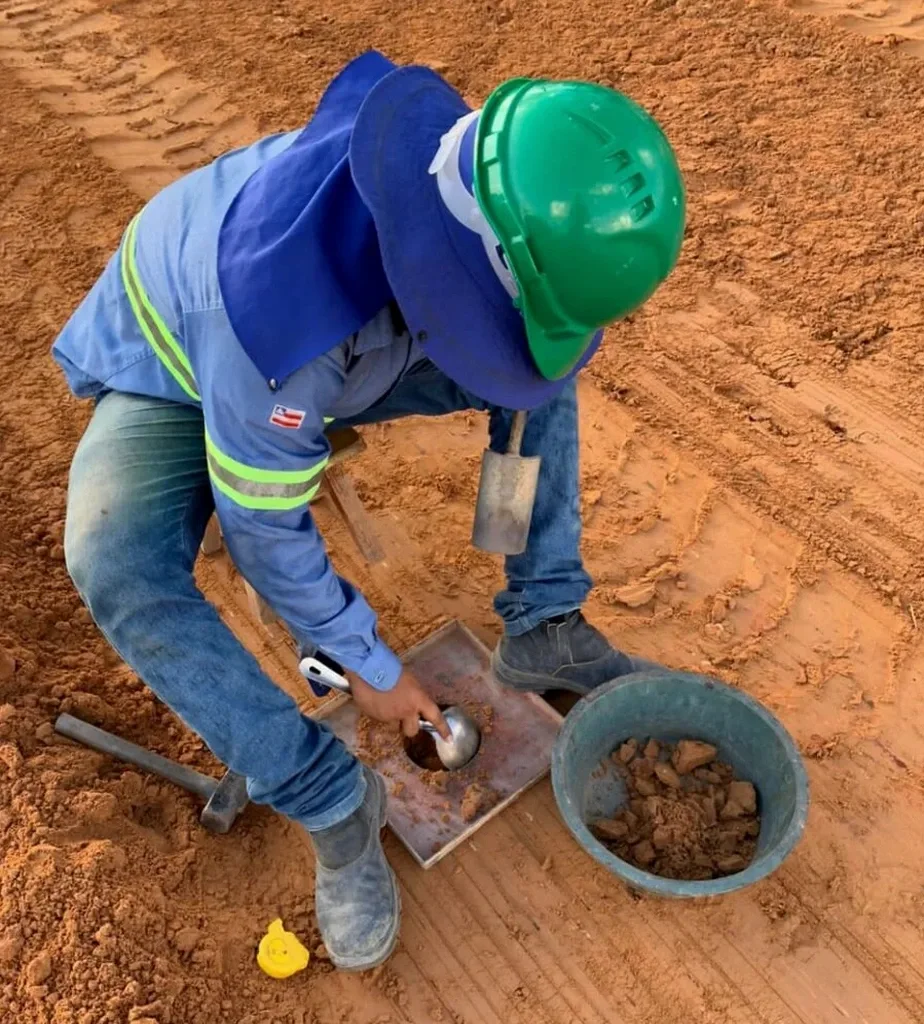
The field kit itself is deceptively simple: a double-cone sand jar, a base plate with a machined funnel opening, a calibrated container of Ottawa sand, and a portable scale. The technician sets the plate on the compacted surface, digs a clean circular hole through the base opening, and collects every gram of excavated soil. Sand flows from the jar into the cavity and funnel; the mass difference divided by the pre-calibrated sand density yields the volume. Subtract the funnel correction, and you have the exact volume of the hole. The risk in Terrebonne comes from vibration—nearby compaction equipment transmitting ground-borne energy can densify the sand column in the jar before the test is complete, leading to an erroneously high volume reading and an under-reported field density. Our protocol requires a 3-metre exclusion zone from active rollers during the sand flow phase. For cohesive fill placed during the short summer construction window, we verify that the moisture content is within ±2% of optimum before accepting the density result; otherwise, the number looks good on paper but fails after the first heavy rain.
Our services
Field density testing in Terrebonne is rarely a standalone scope. Most projects combine compaction verification with supporting geotechnical works to close the loop between design assumptions and as-built conditions.
Compaction Control Program
Proctor reference curves, lift-by-lift sand cone testing, and moisture correction recommendations for residential, commercial, and municipal infrastructure projects across Terrebonne.
Utility Trench Backfill Verification
Density testing within narrow excavations for sewer, watermain, and storm drain installations, with documentation formatted for Ville de Terrebonne acceptance.
Subgrade Evaluation Prior to Paving
Sand cone density combined with CBR sampling to confirm that the prepared formation meets the structural requirements of the pavement design before asphalt placement.
Questions and answers
How many sand cone tests are needed per lift on a typical Terrebonne residential lot?
Most inspectors and geotechnical reports specify a minimum of one test per 150 square metres of compacted area, with at least one test per lift. For a standard 500 m² foundation pad, that typically works out to three or four tests per lift, with additional tests at any area where the material type changes or where the compactor has had limited access.
What does a sand cone field density test cost in Terrebonne?
Individual sand cone tests generally fall between CA$130 and CA$180 per point, depending on the number of tests scheduled per mobilization and the travel distance within the MRC Les Moulins territory. A full-day program with multiple lifts tested on a single visit brings the per-test cost toward the lower end of that range.
Can the sand cone method be used when the fill is very wet?
The method works on wet material, but the result must be interpreted carefully. If the field moisture content exceeds the optimum by more than 3%, the measured dry density will likely fall below specification even with full compactive effort. In that case, the recommendation is usually to scarify and aerate the lift or to replace the material with drier borrow before re-compacting and retesting.