The Lanaudière region sits on a mix of Champlain Sea clays and glacial till that can mask what lies deeper. In Terrebonne, where the Mascouche River has carved through these soft deposits, you can get dramatic velocity contrasts within a single lot. A standard borehole will tell you the stratigraphy, but it won't give you the shear wave velocity profile—and that is what the NBCC 2020 actually requires for seismic site classification. We run the MASW survey here with a 24-channel setup and 4.5 Hz geophones spaced tight enough to resolve the top 30 meters reliably. It is not a black-box test. The dispersion curve analysis is done manually, layer by layer, because automatic inversion routines often misread the fundamental mode in these interbedded silts and clays. When a developer in Mascouche needed a Class C verification for a six-storey structure, we combined the MASW line with a seismic refraction profile to flag a buried bedrock trough that the original SI had missed entirely.
A reliable VS30 is not about the fanciest equipment—it is about knowing when to discard a mode jump and when to trust a weak fundamental.
Methodology applied in Terrebonne
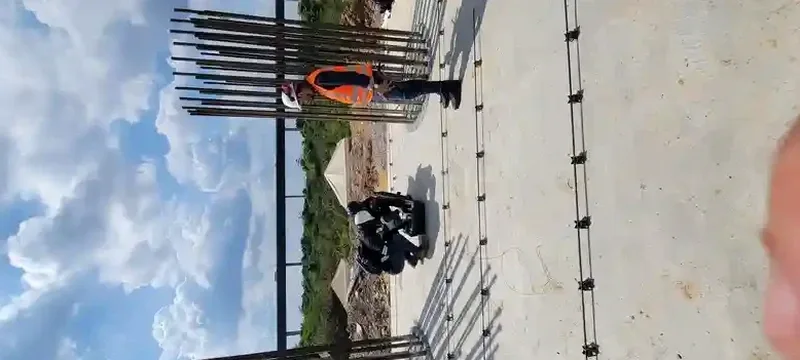
Live process video
Local geotechnical conditions in Terrebonne
The most common issue we see in Terrebonne is a site class downgrade that nobody budgeted for. A developer buys land assuming Class C based on a regional map, but the thirty-meter average comes back at 175 m/s and the site falls into Class D. That triggers higher seismic design forces, heavier reinforcement, and sometimes a complete redesign of the lateral system. It happens more often than anyone admits, especially in the low-lying areas east of Autoroute 25 where the Champlain Sea clay is thick and the bedrock sits below 40 meters. We have had projects where the MASW profile showed a velocity inversion—a softer layer beneath a stiffer crust—that a standard SPT rig would never have caught because the blow counts look fine. The risk is not just a number on a report. It is a foundation designed to the wrong spectral acceleration, and in a province that still remembers the 1988 Saguenay earthquake, that is not a theoretical concern.
Our services
Our Terrebonne testing program covers the full seismic site classification workflow. From initial survey layout to a signed report ready for the municipality, we handle it in-house.
MASW Survey & VS30 Calculation
Active-source MASW with 24- or 48-channel spreads. Average shear wave velocity to 30 m depth calculated per NBCC 2020. Site class A through E assigned with full justification.
Frozen-Ground Corrected Measurements
Winter MASW surveys with empirical correction factors calibrated against local downhole data. Prevents artificial stiffening of the near-surface velocity from frost penetration.
Combined Geophysical & In-Situ Programs
MASW paired with CPT, SPT drilling, or seismic refraction when the stratigraphy is complex. Delivers a unified geotechnical model rather than isolated data sets.
Site-Specific Seismic Hazard Reports
Signed reports for structural engineers covering VS30, site class determination, and spectral acceleration parameters. Suitable for municipal permit submissions in Terrebonne and the MRC Les Moulins.
Questions and answers
What is the typical cost of a MASW survey in Terrebonne?
For a standard active-source MASW line with VS30 calculation and site classification, you are looking at CA$2,550 to CA$4,640. The range depends on the number of spreads needed for the lot geometry and whether we are dealing with frozen ground that requires additional processing. A small residential parcel might need one spread; a commercial site with irregular boundaries could need three or four to cover the footprint properly.
How deep can MASW investigate in the Champlain Sea clay deposits?
With a 69-meter spread and a sledgehammer source, we typically resolve 30 to 35 meters in the local clays. The soft material actually helps—lower velocities mean longer wavelengths for a given frequency, so the Rayleigh waves penetrate deeper than they would in stiff till. If you need to reach bedrock beyond 35 meters, we switch to a heavier weight-drop source or complement with a refraction line.
Does the NBCC require a site-specific VS30 or can I use the default site class?
The NBCC 2020 allows default site classes (usually Class C for most of Terrebonne), but the code also states that a site-specific investigation must be performed where the ground conditions are not well known or where a softer class would increase the design loads significantly. In practice, most municipalities in the MRC Les Moulins will ask for a measured VS30 on any structure over three storeys, and frankly, the default assumption has cost more than one project when the actual class turned out to be D or even E.
How long does a MASW test take on site?
A single spread of 24 channels takes about 45 minutes to set up and shoot, including multiple source positions and a few repeat shots to check repeatability. A full site with three or four spreads is typically completed in a morning. The data processing—manual dispersion curve picking and inversion—takes place back at the lab and adds another day or two before the final report is issued.