Terrebonne sits at an elevation of roughly 20 meters above sea level along the Rivière des Mille Îles, where the post-glacial Champlain Sea deposited thick sequences of sensitive marine clay. With the city’s population now exceeding 120,000, development pressure on these compressible soils has never been greater. A thorough soil mechanics study is what separates a foundation that performs for decades from one that requires costly remediation. Our technical team has characterized the local Leda clay across multiple projects in Terrebonne, understanding how its metastable structure can collapse under shear. Before any excavation or fill placement in sectors like Lachenaie or La Plaine, we recommend complementing the standard investigation with in-situ permeability testing to evaluate drainage behavior, because groundwater control often dictates the success of earthworks in this region.
Characterizing the Champlain Sea clay requires more than index testing; you need to measure its sensitivity and collapse potential before any foundation design proceeds.
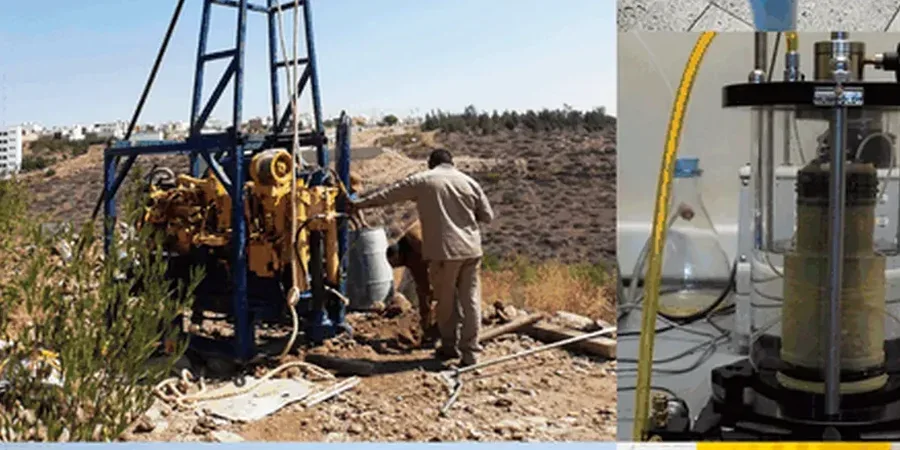
Methodology applied in Terrebonne
Local geotechnical conditions in Terrebonne
The urban expansion of Terrebonne has progressively moved from the stable terraces of the old village core toward the lower compressible plains that were once agricultural land. This shift has multiplied encounters with soft, normally consolidated clays where long-term settlement can reach 150 mm or more under moderate embankment loads. When a soil mechanics study is reduced to a few basic index tests, the critical sensitivity of the deposit is overlooked, and what appears to be a competent material at sampling can turn to a remolded slurry with less than 1 kPa of residual strength if disturbed during construction. We have observed this scenario repeatedly in sectors where trench excavations for sewer and watermain installation triggered lateral spreading because the design assumed intact strength parameters. A properly scoped soil mechanics study in Terrebonne must quantify both peak and remolded strengths, and we frequently pair advanced laboratory testing with field CPT testing to obtain a continuous strength profile that helps identify thin silt seams capable of acting as drainage paths and accelerating consolidation under load.
Our services
The soil mechanics study program we deliver in Terrebonne integrates field sampling, advanced laboratory testing, and engineering interpretation to address the specific challenges posed by the local Quaternary geology. Each service module is designed to produce the parameters required for NBCC-compliant limit states design.
Consolidation and Settlement Analysis
One-dimensional oedometer tests on undisturbed samples to determine compression index (Cc), recompression index (Cr), and coefficient of consolidation (cv), supporting primary and secondary settlement predictions for footings and embankments on compressible clay.
Shear Strength Characterization
Multi-stage CU triaxial and direct shear testing programs that define the Mohr-Coulomb failure envelope under drained and undrained conditions, critical for slope stability, retaining wall design, and bearing capacity verification in Terrebonne's sensitive clays.
Compaction and Permeability Evaluation
Standard and modified Proctor tests combined with flexible-wall permeability (ASTM D5084) to establish compaction specifications and hydraulic conductivity for engineered fill, trench backfill, and stormwater infiltration facilities on local sites.
Questions and answers
What is the typical cost range for a soil mechanics study on a residential lot in Terrebonne?
For a standard single-family home lot in Terrebonne, the laboratory portion of a soil mechanics study generally falls between CA$3,990 and CA$6,090, depending on the number of Shelby tube samples and the specific suite of triaxial or consolidation tests required by the consulting engineer. This does not include the mobile drilling crew's site work, which is quoted separately based on access conditions and depth.
How deep should soil borings go for a foundation on Champlain Sea clay in Terrebonne?
Borings must extend well below the zone of influence of the proposed load. For a typical two-story structure on spread footings in Terrebonne, we sample to a depth of at least 1.5 times the footing width below the bearing elevation, and continue until we penetrate the desiccated crust and reach depth where the added vertical stress is less than 10% of the existing effective overburden pressure. In practice, this often means 8 to 12 meters in the Lachenaie sector.
Which laboratory tests are most critical for evaluating the sensitive clay found in the Terrebonne area?
The consolidated-undrained (CU) triaxial test with pore pressure measurement is indispensable because it captures the undrained shear strength and the generation of excess pore pressure during loading. We complement this with oedometer consolidation tests to define the preconsolidation pressure and the compression indices, and with Atterberg limits and natural water content profiles to assess sensitivity and liquidity index. Together these tests frame the soil behavior for both short-term excavation stability and long-term settlement in Terrebonne.